

ST LUCIA CHARTERS
On the water · Boat safaris · Marine experiences
- WHERE THE WILD MEETS THE WATER
- OUR STORY
- …
- WHERE THE WILD MEETS THE WATER
- OUR STORY
ST LUCIA CHARTERS
On the water · Boat safaris · Marine experiences
- WHERE THE WILD MEETS THE WATER
- OUR STORY
- …
- WHERE THE WILD MEETS THE WATER
- OUR STORY
ST LUCIA · iSIMANGALISO WETLAND PARK · KWAZULU-NATAL
TURTLE TOURS ST LUCIA
Not Your Usual Night Out
Every summer, two ancient ocean travellers return to the beaches of northern KwaZulu-Natal: the loggerhead and the leatherback sea turtle.
From St Lucia, a guided night excursion takes you through the Eastern Shores of iSimangaliso Wetland Park towards Cape Vidal, where the search continues along the coastline according to the tides, access rules and conditions.
There is more to the night than the possibility of seeing a turtle. The reserve changes after sunset. Nocturnal animals become active, the beach takes on a different character, and your guide helps you understand a coastline that has supported turtle nesting for generations.
You may witness a female digging her nest, laying eggs or making her slow journey back to the sea. You may spend the evening looking for signs of activity without encountering a turtle at all. This is wild nature, not a scheduled performance.
Seasonal guided wildlife experience · Departing from St Lucia, subject to operator arrangements and availability
FROM THE BUSH
To the Beach
A turtle tour from St Lucia is part night drive, part coastal safari and part patient wildlife observation. The beach section is governed by the tides, so departure times can change from one evening to the next.
LEAVE ST LUCIA AFTER DARK
Meet your guide at the agreed collection point and travel towards the Eastern Shores of iSimangaliso Wetland Park. Your guide introduces the route, the protected area and the behaviour expected around nesting turtles.
TRAVEL THROUGH THE NIGHT-TIME RESERVE
The drive is an opportunity to look and listen. Depending on conditions and luck, wildlife may include antelope, buffalo, hippos, hyenas or other nocturnal animals. These are possibilities, not promised sightings.
REACH CAPE VIDAL AND THE COAST
After reaching the coast, the authorised tour follows its permitted beach route. Access and driving times depend on tides, safety and the applicable park rules. This is why the departure time isn't necessarily the same every night.
LOOK FOR SIGNS OF TURTLE ACTIVITY
Your guide searches for nesting activity and explains the behaviour you may observe. If a turtle is encountered, the group follows the guide's instructions and keeps the disturbance to a minimum.
RETURN TO ST LUCIA
The return time depends on the itinerary and conditions. Ask when booking about the expected duration, refreshments, transport and collection arrangements.
AN ANCIENT ANIMAL
A VERY MODERN CONSERVATION STORY
Sea turtles have been travelling the world's oceans for millions of years. Yet their survival depends on a surprisingly narrow moment in their lives: the journey from sea to sand, and later from sand back to sea.
Northern KwaZulu-Natal is particularly important because its beaches support nesting by two very different species. Understanding those differences makes the night more meaningful than a simple wildlife checklist.
The loggerhead: built for a life of hard-shelled prey
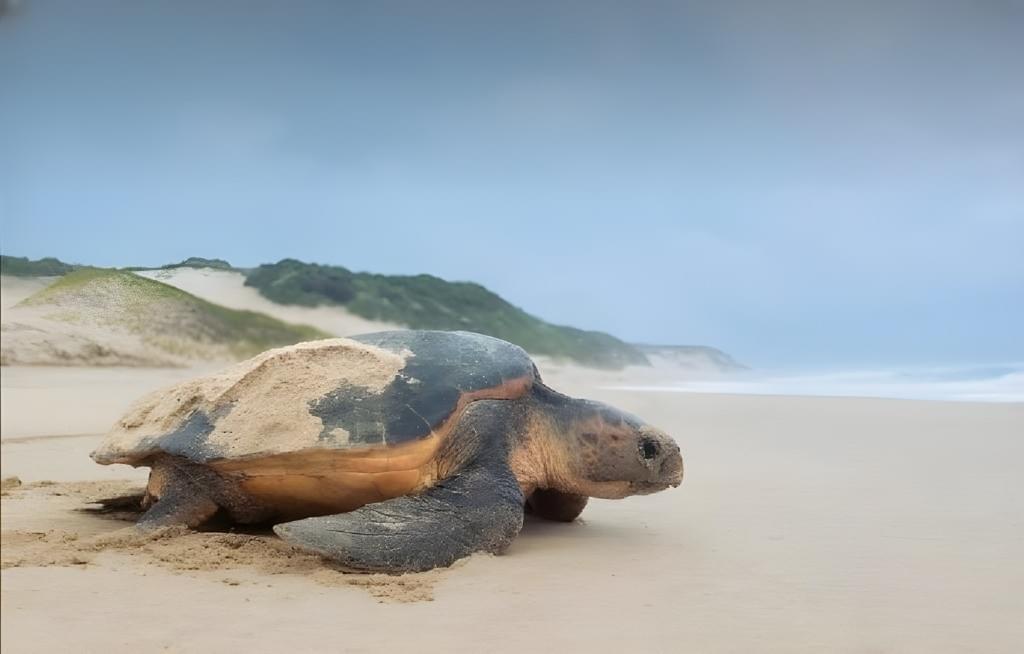
The loggerhead (Caretta caretta) gets its name from its large head and powerful jaws. Those jaws help it feed on hard-shelled animals, including crabs and molluscs.
Loggerheads migrate across large areas of ocean, but nesting females must eventually return to a suitable beach. Once ashore, a female excavates a nest in the sand, deposits her eggs and covers them before returning to the sea.
The process is physically demanding. On land, a turtle that is well adapted to life in the ocean becomes vulnerable to disturbance, obstacles and human interference.
The leatherback: a giant with a very different shell
The leatherback (Dermochelys coriacea) is the largest living sea turtle. Rather than the familiar hard, plated shell of other sea turtles, it has a flexible, leathery covering over a framework of small bones.
It is also a long-distance ocean traveller, with a diet dominated by soft-bodied animals such as jellyfish. That diet links its survival to healthy marine food webs and makes plastic pollution a particular concern: floating plastic can be mistaken for prey.
Seeing a leatherback on a nesting beach, if you're fortunate enough to encounter one, puts the scale of this animal into perspective. An animal adapted to open-ocean life has hauled itself onto land to reproduce.
THIS COAST
HAS BEEN KEEPING RECORDS SINCE 1963
1963
Monitoring began
A long-running programme was established to monitor and protect nesting sea turtles along this coastline.
2
Principal nesting species
Loggerhead and leatherback turtles regularly nest on northern KwaZulu-Natal beaches.
Why is monitoring so important?
A nesting beach isn't simply a place where turtles happen to appear. Repeated monitoring helps conservation teams track nesting activity and changes in populations over time, while protecting females during a vulnerable stage of their life cycle.
The programme along the Greater St Lucia coastline began in 1963. It is one of the longest-running continuous turtle monitoring programmes of its kind, making this coastline important not only to visitors but also to long-term conservation work.
Why do turtles return to land at all?
Sea turtles spend most of their lives at sea, but females must come ashore to lay their eggs. Nesting usually happens at night. The female digs a nest, lays a clutch of eggs and covers it before returning to the ocean.
She doesn't stay to raise her young. Once hatchlings emerge, they must make their own way to the sea, facing predators and other hazards from their first moments outside the nest.
Why does the moon or tide matter to a tour?
The tour's beach access is affected by the tides and permitted operating windows. The guide and operator must work within those constraints. This means the departure time, duration and beach route can vary, even during the same week.
Can you see hatchlings?
Possibly, depending on the season and natural activity. Nesting and hatching do not happen to a visitor timetable. An evening focused on nesting females may not include hatchlings, and no responsible operator should promise a sighting.
THE TURTLE COMES FIRST
The point of a guided turtle tour is not to get as close as possible. It is to observe protected wildlife without interfering with its behaviour.
- Stay with your guide. The guide controls the approach, viewing position and lighting.
- Keep noise down. A quiet group makes it easier to observe wildlife without unnecessary disturbance.
- Never touch a turtle, hatchling or egg. Don't block a turtle's route between the nest and the ocean.
- Follow photography rules. Lighting and flash use are subject to the applicable park rules and guide instructions.
- Leave the beach as you found it. No litter, collecting or interference with nests.
- Accept that wildlife sets the pace. If a turtle isn't encountered, the outing is still a night in a protected coastal ecosystem.
The park's turtle-tour rules specify controls for vehicles, viewing lights and hatchling handling. The authorised guide's instructions take precedence during the outing.
BEFORE YOU HEAD OUT
Duration
Some published St Lucia itineraries run for around six hours, but timing varies with tides, route and operator. Confirm the expected return time when booking.
What to wear
Comfortable clothing and a warm layer are sensible choices for an open vehicle and a late return. Ask the operator about footwear and any specific clothing guidance.
Photography
Bring a camera only if you're comfortable following the guide's lighting and viewing instructions. Photographing wildlife must never take priority over its welfare.
Children and accessibility
Age limits, walking requirements and suitability vary by operator. Tell us the ages of your children and any mobility considerations before requesting a booking.
Children and accessibility
Age limits, walking requirements and suitability vary by operator. Tell us the ages of your children and any mobility considerations before requesting a booking.
Availability and price
The date, tide, current operating rules and available concession arrangements affect the tour. We'll confirm the current price and inclusions before you commit.
MAKE A NIGHT OF IT
Experience the Beauty of iSimangaliso
If you're staying in St Lucia during turtle season, send us your dates and group details. We'll help you check the available guided turtle-tour arrangements, including departure details, itinerary, price and what's included.
No wildlife promises. No guesswork about the logistics. Just clear information so you can decide whether the experience fits your trip.
Frequently asked questions
Where do St Lucia turtle tours take place?
Tours advertised from St Lucia commonly travel through iSimangaliso Wetland Park towards Cape Vidal, then follow an authorised beach route to look for nesting turtles. The exact route depends on the operator and conditions.
Are turtle sightings guaranteed?
No. Turtles are wild animals, and their behaviour cannot be scheduled. A tour provides a guided opportunity to look for activity, not a guaranteed encounter.
Which turtles might I see?
The two principal nesting species on this stretch of coast are the loggerhead and leatherback sea turtles. Both are marine reptiles that come ashore to lay eggs.
Why do departure times change?
Beach access is affected by tides and permitted operating windows. This can change the departure time and duration of the outing.
When is turtle season in St Lucia?
The main season is generally in the Southern Hemisphere summer, often described as November to February or March. Ask about the operator's current dates and whether the tour is focused on nesting or hatchling activity.
Can we take photographs?
Photography must follow the applicable park rules and guide instructions. Lighting is controlled to minimise disturbance. Ask your guide before using a camera light or flash.
Is a turtle tour a boat trip?
The St Lucia-to-Cape Vidal turtle outing described on this page is a guided land-and-beach wildlife excursion, not a boat safari. If you're looking for a boat experience, see our estuary and marine trips instead.
ST LUCIA CHARTERS
GO A LITTLE DEEPER
MADE IN ST LUCIA
ROOTED IN ZULULAND
iSimangaliso Wetland Park
KwaZulu-Natal · South Africa
EXPLORE
Experiences
Packages
Stays
Destinations
DISCOVER
Our Story
Local Knowledge
FAQs
GET IN TOUCH
Contact Us
Trade & Partnerships
St Lucia Africa — Go a little deeper
Connecting visitors with accommodation, land-based safaris, local experiences, wildlife areas and trip-planning information.
Kampeer Africa — Sleep outside
Kampeer Africa helps travellers discover campsites, national parks, coastal wilderness, safari destinations and road-trip routes.
St Lucia Charters — Wild Coast
St Lucia Charters offers boat safaris, estuary cruises, whale watching, ocean exploration, and deep-sea fishing experiences around St Lucia, iSimangaliso Wetland Park,KwaZulu-Natal, South Africa.
ST LUCIA CHARTERS
All Rights Reserved
2026